
On 13 May 2026 Amazon retired the name Rufus and the shopping assistant became Alexa for Shopping. Most of the coverage reported the name. The name is the least interesting thing that changed.
Three things happened at once, and only one of them was cosmetic.
| What changed | Why it matters |
|---|---|
| A product merge. Rufus's product and catalog expertise was combined with Alexa+'s personalisation and cross-device memory into a single assistant. | The assistant now carries context between sessions and devices. It is not answering each question cold. |
| A surface was retired. The standalone Rufus chat panel was discontinued as a separate product. | There is no longer a place a shopper opts in to. The assistant is not a feature they choose. |
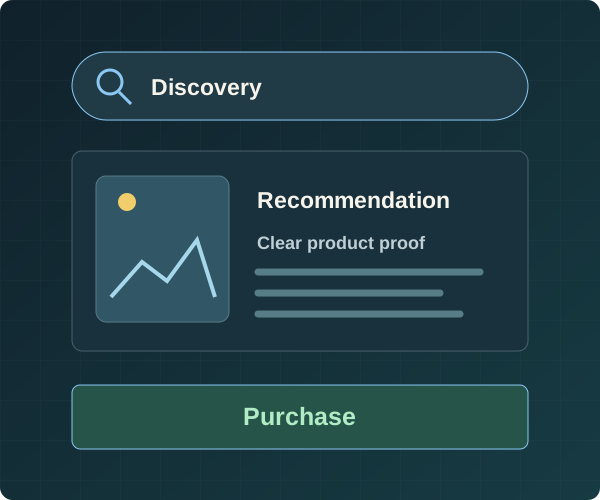
| It moved into the search bar. | This is the consequential one, and it is the least reported. A shopper does not decide to use it. They type where they have always typed. |
"Rebrand" undersells it and "Rufus was discontinued" overstates it. The precise statement is that Rufus was merged into Alexa+, the combined product was named Alexa for Shopping, and the standalone chat surface was retired.
Rufus Did Not Disappear, Which Matters More Than It Sounds
The old name is still doing work in three places, and knowing which is which keeps you from making a claim you cannot support:
- In Amazon's own advertising documentation. Amazon's March 2026 announcement of Sponsored Products and Sponsored Brands prompts describes a prompt as something that "may open a dialog in Rufus". That post predates the rename, and we have not verified whether the wording has since been updated, so treat it as evidence of how recently the name was current rather than as a claim about today.
- As practitioner vocabulary. Almost every guide published since May is titled some variant of "Alexa for Shopping (formerly Amazon Rufus)". The old name is carrying the search traffic, which is a reasonable argument for keeping it in your own titles for a while yet.
- Under the hood. It is widely reported that the recommendation capability continues to power parts of the experience. We have not found an Amazon statement to that effect, so we are not going to put it in Amazon's mouth.
Naming is current for the United States. Amazon's launch post describes availability to US customers, and other marketplaces may still show the older branding.
The Part Nobody Is Reporting: There Is No Report
Here is the thing that should occupy an operator far more than the name.
The assistant has become a significant discovery surface, and there is no organic visibility metric for it in Seller Central.
You can see your organic rank for a search term. You can see impressions, click share, conversion share. For assistant recommendations there is no equivalent: no impression count, no share metric, no query report. If a competitor is being recommended in answer to a question your product should own, nothing in your account will tell you.
What Amazon did build is the paid route. Sponsored Products and Sponsored Brands prompts left beta in March 2026 and became billable placements. So the only assistant visibility with reporting attached to it is the visibility you buy. That is not an accusation, it is how most surfaces begin, and it is exactly what happened with search itself. But it does mean that anyone selling you "AI visibility optimisation" against an organic outcome is selling something neither of you can measure yet.
The Best Evidence Available, and Who Paid for It
The strongest published study is Marketplace Pulse, 16 July 2026: 1,963 non-branded queries and 12,810 captured recommendations, collected across May and June 2026.
- 63.9% of the assistant's picks fell outside the organic top 10 for the matched term.
- 40.9% never appeared on the visible search results pages at all.
- Only 14.3% of recommendations had sponsored listings on the search page, and 83% of those already ranked organically anyway.
If that holds, it falsifies the most common pitch in the category, which is that ranking well organically is how you get picked by the assistant. On these numbers, rank is not the mechanism.
Cited with its provenance stated: Marketplace Pulse is an independent outlet, but the underlying data is credited to an AI-optimisation vendor, that is, a company whose product is sold on the premise that AI discovery is a separate channel requiring separate work. The finding is exactly what that business model needs to be true. It is still the best evidence in the field, and it is worth reading with that in mind.
What the Evidence Does Not Support
A short list, because the gap between what is circulating and what has been tested is unusually wide here. Each of these is repeated confidently across the industry and none of it has a published test behind it that we could find:
- That A+ Content is read in full by the assistant while being invisible to traditional search. This is the single most repeated claim in the space. It is plausible. It is not verified, and nobody quoting it has shown a test.
- That structured attributes are "the first gate" the assistant evaluates. Directionally sensible, since an empty field cannot answer a question about who a product is for. Presented with far more mechanical precision than anyone has earned.
- Any specific percentage of Amazon sessions or searches said to involve the assistant. Several are in circulation. We could not trace one of them to a source, and at least one attributes an Alexa for Shopping figure to a period before Alexa for Shopping existed.
There is one genuinely careful study worth naming: AMALYTIX analysed patterns across 1,300+ recommendations in November 2024, and stated plainly in its own write-up that correlation is not causation and that the patterns may simply reflect what shoppers prefer generally. That study predates the rename by eighteen months and looked at Rufus. Its most-quoted finding, a median title length of 166 characters, is now obsolete anyway: Amazon capped titles at 75 characters in most categories on 27 July 2026.
The Contrarian Read Is Worth Holding
Not everyone thinks this matters yet, and the sceptical position is falsifiable, which is more than can be said for most of the optimism. The argument is that the assistant cannot read text embedded in images and therefore cannot act on it, and that summaries appear on a minority of queries. Both are testable. Neither has been disproven.
The honest position for an operator sits between the two: this is a real surface with real traffic and no measurement, which means it deserves attention proportionate to the evidence, not proportionate to the noise.
Takeaway
Do not buy an "AI visibility" programme priced against an outcome nobody can measure. Do make sure the answers are present in your catalog: the attributes filled in, the questions a buyer actually asks answered somewhere in the listing rather than implied by an image. That work pays whether or not the assistant is reading it, which is exactly why it is the right work to do while the evidence is thin.
One Prediction Worth Noting
In March 2025, more than a year before the merge, Andrew Bell argued publicly that Amazon would fuse Alexa's voice layer with Rufus's product intelligence. That is what happened, fourteen months later. It is worth citing because it suggests the direction is structural rather than reactive: a single assistant with memory, sitting in the search bar, is where this was always going.
Which means the reporting gap is the thing to watch. When Amazon gives the assistant an organic visibility metric in Seller Central, this becomes a channel you can manage. Until then it is a channel you can only prepare for, and preparing means having a catalog that answers questions rather than one that lists features.