
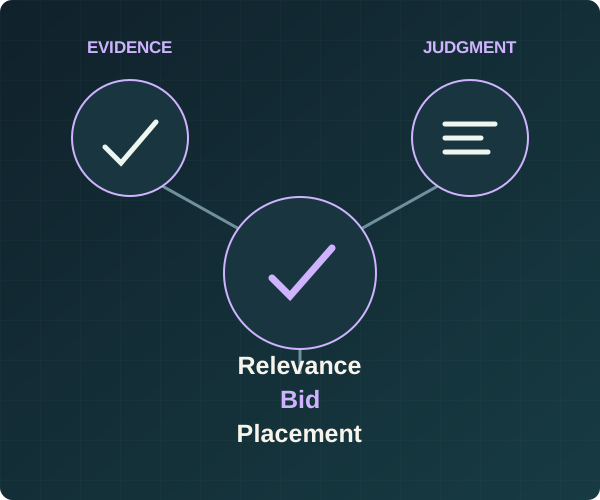
Amazon advertising is usually explained as three campaign types and a bidding strategy. That is the interface, not the mechanism. The mechanism is an auction with a relevance filter in front of it, and understanding the filter is what separates spending money from buying position.
The Auction Is Not Only About Money
You do not simply outbid your way onto a page. Amazon decides which ads are eligible to compete for a query, and only then does the auction run. Eligibility is a relevance judgement, informed by your listing's structured data and its history of converting for that kind of query.
Two consequences follow, and they are the ones most operators discover late:
- A poor listing makes advertising more expensive, permanently. If your product converts badly for a term, you pay more for less of it, and no bid strategy fixes a conversion problem.
- Advertising and organic are not separate systems. Ad-driven sales contribute to the sales history that informs organic position. Cutting advertising on a term you are ranking for often costs you the rank a quarter later, which looks like an unrelated decline.
The Three Campaign Types Answer Different Questions
| Type | The question it answers |
|---|---|
| Sponsored Products | Someone is looking for this kind of thing right now. Should it be us? |
| Sponsored Brands | Someone is at the start of a decision. Can we frame the category before they narrow it? |
| Sponsored Display | Someone looked and did not buy, or is looking at a competitor. Is there a second chance worth paying for? |
Most accounts run all three and measure them the same way, which guarantees the two that are not bottom-of-funnel will look like they are underperforming. Sponsored Brands judged on last-click return will always lose to Sponsored Products, and cutting it usually reduces the number of people arriving at the term Sponsored Products is winning.
Three Kinds of Keyword, Three Different Jobs
Averaging these together is the most common analytical error in the channel, because a single blended efficiency number hides the fact that they are not supposed to perform alike.
- Brand terms. People searching for you by name. Cheap, high converting, and partly defensive: you are often paying to stop a competitor appearing above your own listing. Judge on cost of defence, not on return.
- Generic terms. People describing the product without naming a brand. Expensive, lower converting, and the only route to buyers who do not know you exist. Judge on new-to-brand and on organic position over time, not on immediate return.
- Competitor terms. People naming somebody else. Expensive, usually poor converting, occasionally worth it for a genuinely differentiated product. Judge honestly, and be willing to stop.
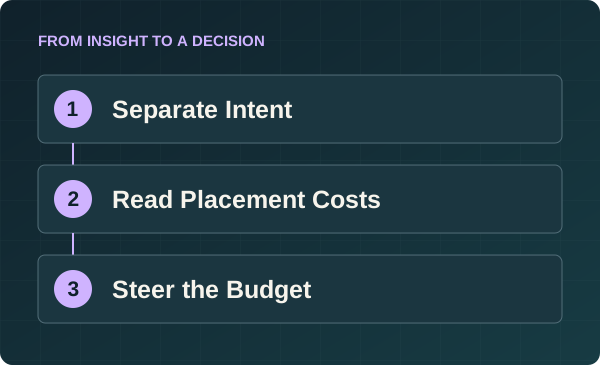
One blended efficiency number across all three tells you nothing you can act on, because the correct target for each is different.
Placement Is Where Economics Actually Differ
The same keyword behaves like a different keyword depending on where the ad renders. Top of search converts better and costs more. Rest of search and product pages are cheaper and behave differently again. An account managed at the keyword level without placement modifiers is leaving the most controllable variable untouched.
The same is true of child versus parent. Reporting at parent level averages a strong variant with a weak one and hides both, and the decision you need, which is which variant to push, is invisible at that altitude.
The Assistant Is Now a Billable Placement
Sponsored Products and Sponsored Brands prompts left beta in March 2026 and became billable placements inside Amazon's shopping assistant. That is worth knowing for two reasons: it is a genuinely new inventory type, and it is currently the only assistant visibility that comes with reporting attached. There is no organic equivalent metric in Seller Central.
What a Tool Cannot Do
Every automation platform will execute a bad instruction perfectly. The judgements that decide whether a channel is profitable are not the ones a rules engine makes:
- Whether a term is worth losing money on because it builds organic position.
- Whether a campaign should be paused, and the usual answer is no, because restarting it costs the learning.
- Whether soft numbers are your problem or the category's, which requires looking outside your own account entirely.
- Which products should not be advertised at all, because they do not contribute at current fees.
Takeaway
Separate brand, generic and competitor terms before you look at any efficiency number, and set a different target for each. Most accounts that feel stuck are averaging three jobs into one metric and optimising toward the average, which quietly starves the only part that brings new customers.