
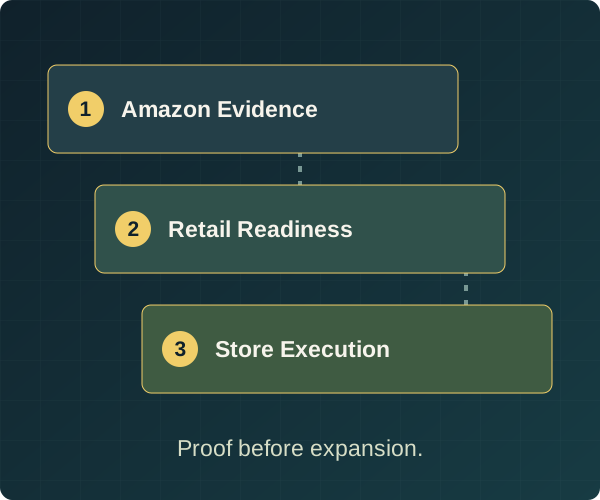
Amazon-native brands often treat retail as the next size up, as though it were the same business with bigger orders. It is a different business with a different cost structure, a different buyer, and a different definition of failure.
The good news is that a well-run Amazon business generates exactly the evidence a retail buyer wants, and most brands do not realise they are already holding it.
What Transfers, and It Is More Than Brands Expect
- Demonstrated demand. A retail buyer's core question is whether anyone wants this. Sales history, review volume and repeat rate answer it with evidence rather than a forecast, which is a stronger position than most brands pitching them.
- Category and price-band data. You know what shelf your product sits on, what it sits beside and what price the market has already accepted, because you have been testing it live.
- Content and imagery. The photography, the copy and the claims are largely reusable, and the discipline of writing for a shopper who cannot touch the product transfers well to a shelf.
- Operational maturity. If you can forecast, hold service levels and manage a catalog for Amazon, you have most of the muscles retail requires.
What Does Not Transfer, and This Is Where It Goes Wrong
- Margin structure. Retail buys at a wholesale price and expects support: promotional funding, allowances, sometimes slotting. If your model is built on a marketplace margin, the same product can be unprofitable through retail at volumes that look like success.
- Packaging. Amazon packaging optimises for shipping a single unit safely. Retail packaging has to sell from a shelf at arm's length, survive a pallet, fit a planogram and often carry different regulatory marks. This is a real project, not an adjustment.
- Lead times and commitment. Marketplace inventory decisions are reversible in weeks. A retail purchase order is a commitment months ahead against a forecast you do not control.
- Who the customer is. Your customer becomes the retailer. The shopper is their customer. That changes what you optimise and who you have to satisfy.
- Price visibility in both directions. Your Amazon price is visible to the buyer you are negotiating with, and your retail price becomes visible to your Amazon shoppers. The two channels now constrain each other permanently.
The most common failure is not being rejected. It is winning the order and discovering the unit economics only work at a volume you cannot hold.
The Channel Conflict Nobody Plans For
Once a product is in retail, your Amazon price is a competitive fact in your buyer's world. Discount aggressively online and you undercut a partner who committed shelf space to you. Hold price online and you may lose marketplace position to sellers who will not.
This is resolvable, and it is resolved before the first order rather than after: differentiated pack sizes, channel-specific SKUs, an agreed pricing floor. All of those are decisions to make while you still have leverage, which is before you need the deal.
Sequencing That Works
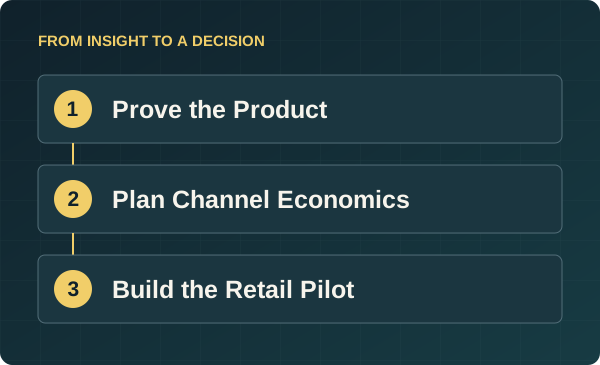
- Prove it where proof is cheap. Marketplace performance is your evidence. Do not approach retail until the sales history says something a buyer would find persuasive.
- Model the retail P&L before the conversation. Wholesale price, promotional support, expected returns, packaging cost. Know the volume at which it works and the volume at which it does not.
- Decide the channel architecture first. Which SKUs go where, at what prices, and what happens when they collide.
- Fix packaging before you pitch. A buyer meeting where the packaging is theoretical is a meeting you will have twice.
- Start narrow. One retailer, a limited range, a region. Retail punishes service failures far harder than a marketplace does, and the first order is where you learn whether your operation can hold.
Takeaway
Build the retail P&L before the first buyer conversation, not after the first order. The brands that struggle in retail are usually not the ones who could not get in. They are the ones who got in on terms that only worked at a volume nobody had committed to.