
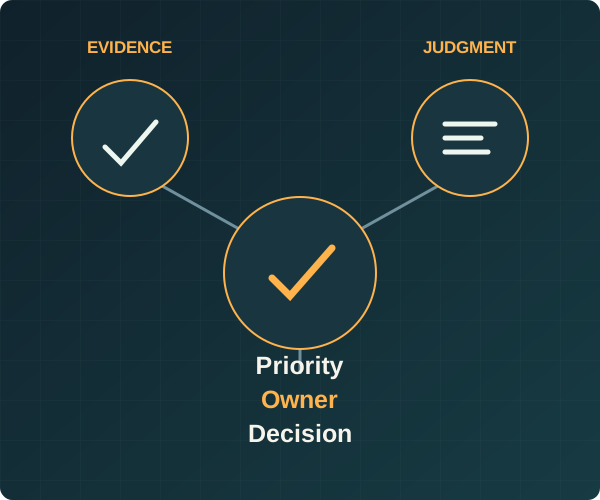
Most Amazon account management is reporting with a meeting attached. A deck arrives, the numbers are read aloud, everyone agrees the numbers are the numbers, and the next deck arrives a month later. Nothing in that loop requires anybody to own an outcome.
I spent nine years inside Amazon managing vendor accounts, and the difference between the accounts that grew and the accounts that did not was almost never the quality of the reporting. It was whether a specific person was accountable for a specific number, and whether that person had the standing to do something about it.
Reporting Is Not Management
Reporting describes what happened. Management changes what happens next. They are different jobs and they need different people, which is why an account can be beautifully reported and quietly stagnant at the same time.
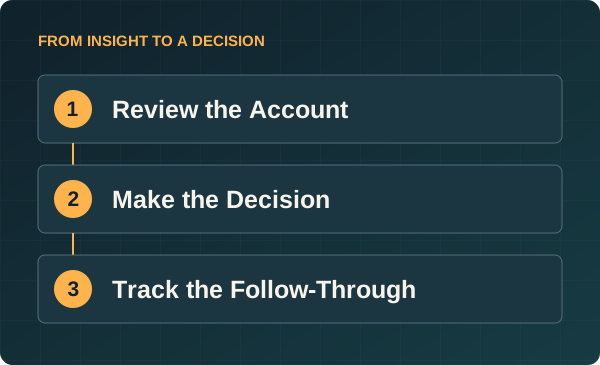
The tell is simple. In a reporting relationship, the meeting ends with information. In a management relationship, the meeting ends with decisions, owners and dates. If your last four account reviews produced no decision that changed something, you are buying reporting.
The Four Things a Real Account Owner Owns
Everything that actually moves an Amazon business sits in one of four places. Good account management means someone is answerable for each of them by name.
- Catalog integrity. Every listing live, correct, complete and attached to the right variation family. This is unglamorous and it is where the majority of silent revenue loss happens, because a suppressed or mis-variated listing does not generate an alert to anyone outside the account.
- Availability. In stock, in the right quantity, in the right place. A stockout does not just cost the sales during the stockout. It costs the rank, and rank takes considerably longer to rebuild than inventory does.
- Demand. Advertising, promotions, deals and the organic position they are meant to be building toward.
- The P&L. Fees, fulfilment, returns, storage and net contribution. Someone has to be reading this, or the first three can all improve while the business gets worse.
If you cannot name the person accountable for each of those four, they are not being managed. They are being reported.
The Cadence, and What It Is For
A working cadence is not a meeting schedule. Each interval exists because a different class of problem becomes visible at that interval, and running them all at the same frequency guarantees that some problems are found late.
| Interval | What it catches |
|---|---|
| Daily | Suppressions, stockouts, buy box loss, pricing errors. Exceptions only, no meeting. |
| Weekly | Advertising efficiency, new search term behaviour, inventory cover, live issues. |
| Monthly | Contribution margin by SKU, catalog health audit, returns by reason. |
| Quarterly | Assortment decisions, pricing architecture, expansion, and what to stop. |
The daily layer is the one most often missing, and it is the cheapest to run because it should be exception-driven rather than a report anyone reads. If a listing goes down on a Tuesday and it is found in the Thursday meeting, two days of sales and some rank are gone before anyone knew there was a problem.
Escalation Is a Skill, Not a Ticket
Every Amazon business eventually needs something resolved that cannot be resolved through the standard route. A case gets closed without being read. A suppression cites a policy the listing already complies with. A chargeback is issued against a shipment that was received.
The people who get these resolved are the ones who know which team actually owns the decision, what evidence that team needs, and how to write a case so that the first reader can act on it without asking a question. That is a learned skill and it is the single clearest difference between someone who has worked inside the system and someone who has only worked against it from outside.
Takeaway
Ask your current account team to walk you through the last three escalations they opened: what the issue was, who they took it to, what evidence they attached, and how long it took to close. The answer tells you more about the quality of your account management than any monthly deck will.
What Junior Account Management Costs
The standard agency model puts a junior manager on the day-to-day and a senior name on the pitch. That model is not dishonest, and for a small catalog it is often adequate. It breaks on scale and on ambiguity.
It breaks on scale because a large catalog generates more exceptions than a junior manager can triage, so the exceptions get worked in the order they arrive rather than the order they matter. It breaks on ambiguity because the decisions that matter most, such as what to stop selling or how to reprice a family, are judgement calls that a junior manager is not empowered to make and will therefore defer. Deferred decisions are invisible in reporting. They only show up as a business that is being maintained rather than grown.
How to Tell in One Meeting
You do not need an audit to work out which kind of relationship you have. Four questions will do it:
- What did you decide to stop doing last quarter, and why? A manager can answer this. A reporter cannot, because stopping something is a decision.
- Which SKUs are unprofitable at current fees? If the answer is that nobody has calculated it, the P&L is not being owned.
- What is the plan for the two lowest-performing listings? The question is deliberately about the worst performers, because that is where the absence of a plan is most visible.
- What broke in the last thirty days and how fast did you find it? Everything breaks eventually. Detection speed is the measurable part.
Good account management is not exotic. It is a small number of things owned by a named person with enough seniority to act, run on a cadence that catches problems while they are still small. Most brands are not being badly served. They are being reported to, and calling it management.
The mechanism we use to make that concrete is tracked accountability: every promise made on an account carries an owner and a date, and sits in exactly one of eight states until it closes. One of those states exists specifically for the thing this article is about, the commitment that is overdue and that nobody has mentioned.