
Brands usually arrive at this question having already decided the answer is one or the other. It is worth slowing down at that point, because an agency and a fractional executive are not two prices for the same thing. They solve different problems, and buying the wrong one is expensive in a way that takes about two quarters to become visible.
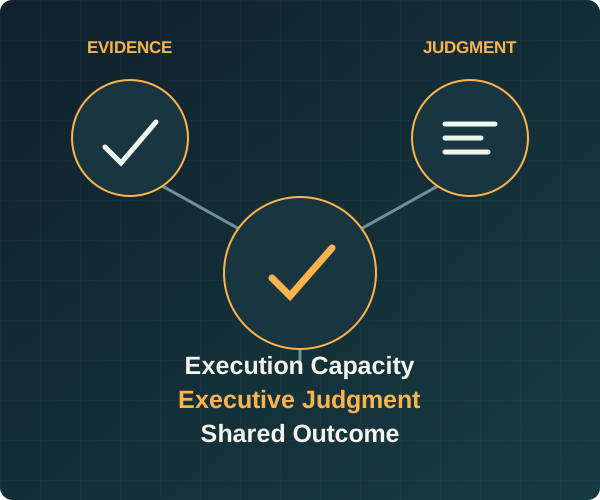
The short version: an agency supplies capacity. A fractional executive supplies judgement and accountability. Most brands buy capacity when what they are short of is judgement, because capacity is easier to scope, easier to price, and much easier to put in a procurement document.
What an Agency Is Genuinely Good At
This is worth saying plainly, because the fractional pitch usually skips it. A good agency gives you things that are hard to build:
- Throughput. Several people can work several workstreams at once, and the work does not stop when one person is on holiday.
- Specialisation. The person writing your listings is not the same person managing your bids, and neither is learning on your account.
- Pattern recognition across accounts. An agency has seen your problem before, on a catalog that is not yours, which is genuinely useful.
- Surge. A launch, a Prime event, a catalog migration. Work that needs six people for three weeks and nobody for the rest of the year.
What It Is Structurally Bad At
These are not criticisms of any particular agency. They are properties of the model, and a good agency will tell you about them.
- An agency owns a scope, not an outcome. The contract describes work to be performed. If the work is performed and the business does not grow, the contract was still honoured. That is not bad faith, it is what the document says.
- The day-to-day sits with whoever is available. The senior name on the pitch is usually not the person in your account on a Tuesday, and the model depends on that being true.
- Nobody is empowered to say stop. The decisions that matter most are usually about what to discontinue: a SKU, a campaign, a channel. An agency is not positioned to recommend doing less of the thing it is paid to do.
Ask an agency what they told a client to stop doing last quarter. The answer, or the absence of one, tells you which model you are buying.
What a Fractional Executive Is Good At
A fractional executive is a senior operator working part of their time on your business, with the standing to make decisions rather than recommend them.
- Deciding, not proposing. Priority, sequencing, and what does not get done this quarter.
- Working across functions. Marketplace decisions that involve supply, finance and brand do not sit inside an advertising scope.
- Saying no. Including to work that would have been billable.
- Carrying the number. One person accountable for the channel P&L rather than for a set of deliverables.
And What a Fractional Executive Cannot Do
They are one person for part of a week. They cannot rewrite two hundred listings, run daily bid management, produce creative, and handle a case backlog. A fractional executive with no team underneath is a very well-informed bottleneck, and the failure mode is a brand that has excellent strategy documents and an unchanged catalog.
The Question That Actually Decides It
Is your problem a decision problem or a throughput problem?
| What you are experiencing | What it usually means |
|---|---|
| Work is happening, nothing is compounding | Decision problem |
| Everyone agrees on the plan, nobody has capacity | Throughput problem |
| The same issue is raised every month and never closes | Ownership problem, which is a decision problem wearing a schedule |
| Reporting is excellent, margin is falling | Decision problem |
| Launches slip because nobody is free | Throughput problem |
Takeaway
Write down the last five things that did not get done, and mark each one as either "nobody decided" or "nobody had time". If most say nobody decided, more hands will not fix it, and a bigger retainer will make it worse.
Why We Run Both
We think the honest answer for most mid-sized and larger catalogs is both, which is why our model is built that way rather than as a preference. The executive owns the outcome and makes the calls; dedicated resources underneath do the volume. Neither half works without the other, and we say so on the page that explains how we track what we commit to, because a model with two halves has twice as many places for a promise to go quiet.
If your catalog is small enough that one senior person could genuinely execute it alone, a consultant or a fractional executive on their own is the right answer and is cheaper than us. That is not a difficult thing to admit; it is just the size of the job.