
The in-house versus agency comparison is usually run as one number against another: a salary against a retainer. That comparison is easy, fast, and almost always wrong, because the salary line is the smallest part of what building the function actually costs.
This is not an argument that in-house is a mistake. For some brands it is clearly right. It is an argument that the comparison most brands run does not contain enough of the real numbers to decide anything.
What a Salary Line Leaves Out
Write the full list before comparing anything. Not amounts, which vary enormously by market and seniority, but lines, because a line you forgot is a line you will pay anyway:
- Recruitment. Agency fees or the internal time to run a search, plus the weeks the role sits empty while you look.
- Ramp. A strong hire is not productive on day one. On a catalog of any size, learning the account, the fee structure and the history takes a quarter.
- Tooling. Analytics, keyword research, listing management, reporting. Individually modest, collectively not.
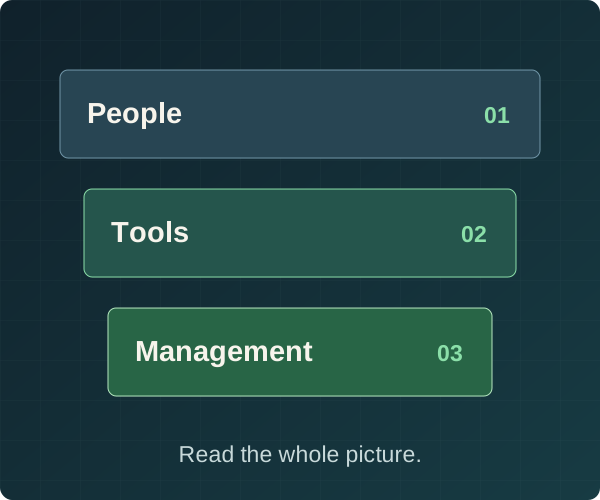
- Management overhead. Somebody senior has to direct this person, review their work, and unblock them. That time comes out of another role.
- Coverage. Holiday, illness, and the day they resign. The channel does not pause.
- Breadth. One person is rarely strong at catalog, advertising, operations and creative. The gaps get filled by contractors, freelancers, or not at all.
The Risk Nobody Prices
A single in-house owner is a single point of failure holding institutional knowledge that exists nowhere else. When that person leaves, and eventually they do, the brand loses the account history, the reasoning behind past decisions, and the relationships, all at once. The replacement then spends a quarter rediscovering what was already known.
The question is not what the role costs. It is what it costs to lose the person doing it.
This is straightforwardly mitigable, and it is worth mitigating whichever model you choose: written decisions, a documented cadence, and a record of what was committed and by whom. We publish how we do that because it is the part of the work that survives a departure.
Where In-House Genuinely Wins
An agency arguing that in-house never works is not being honest with you. In-house wins on real things:
- Brand fluency. Someone who sits in your building absorbs positioning, tone and product roadmap in a way a external partner has to be told.
- Speed on small decisions. No scope conversation, no ticket.
- Institutional memory, as long as it is written down.
- Control, which for some categories and some regulated products is not negotiable.
Where It Genuinely Loses
- Benchmarks. One person on one account has one data point. They cannot tell you whether your conversion rate is good, only whether it went up.
- Surge. A launch or a peak event needs more hands for a few weeks and fewer for the rest of the year, which is the hardest shape to staff.
- The next channel. Walmart, retail, international. Each is a different set of rules, and learning them on the job is slow and expensive.
- Being told they are wrong. An internal hire reporting into the person who hired them is not well positioned to challenge the strategy.
The Shape That Usually Wins
For most mid-sized and larger catalogs the answer is not one or the other. It is a small internal team that owns brand fluency and daily decisions, with senior external ownership of the channel P&L and specialist capacity underneath for the work that is spiky or deep.
The reason that shape wins is not that it is a compromise. It is that the four things you need, which are judgement, breadth, capacity and continuity, are not available from any single person or any single model.
Takeaway
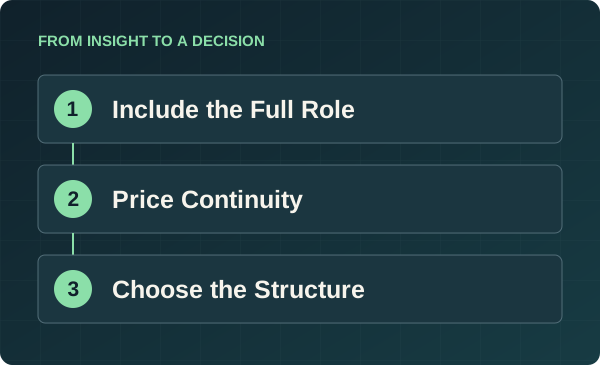
Run the comparison on total cost of the capability, not the cost of a person. List recruitment, ramp, tooling, management time, coverage and the gaps you would fill with contractors, then compare. The answer changes for a meaningful number of brands once that list is complete.
Four Questions Before You Open the Role
- Which of catalog, advertising, operations and creative will this person actually own, and who covers the rest?
- Who directs them, reviews their work, and tells them when they are wrong?
- What happens to the channel in the four weeks after they resign?
- How will you know whether their results are good, rather than simply better than last month?
If the fourth question has no answer, that is the strongest argument for external benchmarking regardless of which model you choose.