
Most agency selection processes are run by the buyer and won by the seller, and the reason is structural rather than sinister: the process measures the pitch, and the pitch is the one part of the engagement built by people who will not be doing the work.
I spent nine years inside Amazon watching brands change agencies, usually for the same reason each time. It was rarely that the agency was incompetent. It was that the brand had bought something different from what it thought it was buying, and nobody found out until the second quarter.
The Pitch Team Is Not the Delivery Team
This is the single most useful thing to internalise before a single meeting. In most agencies the people in the room during selection are senior, articulate, and assigned to selling. The people in your account afterwards are more junior and are carrying several accounts.
That is not a scandal and it is not always a problem. It becomes a problem when nobody said it out loud, so the brand spends a year expecting the judgement it saw in the pitch and receiving the execution it actually bought.
Ask who will be in your account on an ordinary Tuesday, by name and by seniority. Then ask how many other accounts that person carries.
Six Questions Worth More Than a Capabilities Deck
- Who does the work day to day, and what else are they on? A name and a number. Vague answers here predict vague accountability later.
- What did you tell a client to stop doing last quarter? Managers can answer this. Order-takers cannot, because stopping something is a decision.
- How would you find out which of my SKUs are unprofitable? You are testing whether they think in contribution margin or in advertising ratios. Both matter; only one of them pays you.
- Walk me through your last three escalations. What the issue was, who they took it to, what evidence they attached, how long it took. This is the question that separates people who have worked inside the system from people who have only worked against it.
- What do you need from us, and what happens when you do not get it? Every engagement depends on the client for something. An agency that has never thought about this will discover it three months in, as a surprise, in your review.
- How do you get paid, and what makes that number go up? If the answer is "more spend" or "more hours", the incentive is pointed away from you.
Four Things That Should End the Conversation
- A guaranteed rank or a guaranteed sales number. Nobody controls the algorithm or your competitors. A guarantee is either meaningless or it is being paid for out of margin you have not agreed to spend.
- A proprietary system nobody will describe. Tooling is real and useful. A black box that cannot be explained is usually either commodity software with a logo on it, or nothing.
- No view of the P&L. If the proposal never mentions fees, fulfilment, storage or returns, it is an advertising proposal wearing a growth headline.
- An identical cadence for every client. A brand with forty SKUs and a brand with four thousand do not need the same meeting schedule, and an agency that gives them the same one is running a template.
How to Compare Proposals That Are Not Comparable
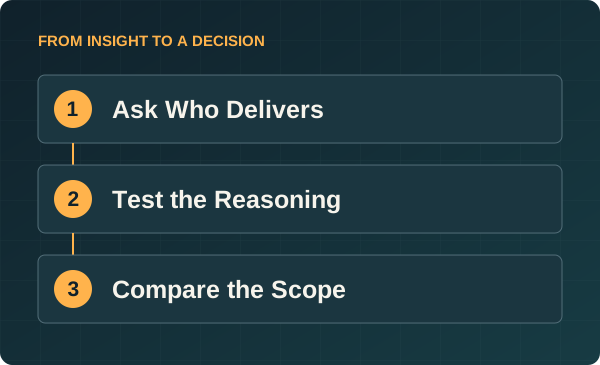
Agency proposals are deliberately hard to compare, because comparison is bad for whoever is more expensive. Normalise them onto three axes before you look at price:
| Axis | What to write down |
|---|---|
| Scope | Which of catalog, advertising, creative, operations and expansion are actually included, and which are quoted separately |
| Seniority | The named person on the day-to-day, their years of experience, and their account load |
| Cadence | What happens daily, weekly, monthly and quarterly, and which of those is a report rather than a decision |
Once those three are written down, the price differences usually explain themselves, and occasionally the cheaper proposal turns out to be the more expensive one per unit of senior attention.
Takeaway
Before you compare fees, write one sentence for each proposal describing exactly who will be accountable for your channel and what they are accountable for. If you cannot write that sentence from the proposal, that is the finding.
What a Good First Ninety Days Looks Like
You can sanity-check any proposal against this shape. A serious first quarter spends the early weeks establishing what is true rather than launching activity: catalog and account health audited, contribution margin established per SKU with current fee inputs, a written priority order with things explicitly deferred, and a cadence started with named owners. Activity that begins in week one without any of that is activity that will be revised in week six.
None of this requires a paid audit to find out. A paid audit is a recommended way to compress the diligence into two weeks with a written deliverable at the end, and it is optional. Any agency that tells you it is the only way in is selling the audit.