
Most listing work is cosmetic. Someone rewrites the bullets, swaps the hero image, adds an A+ module, and the listing looks better without selling more. The work that moves rank is duller than that and happens in places nobody screenshots.
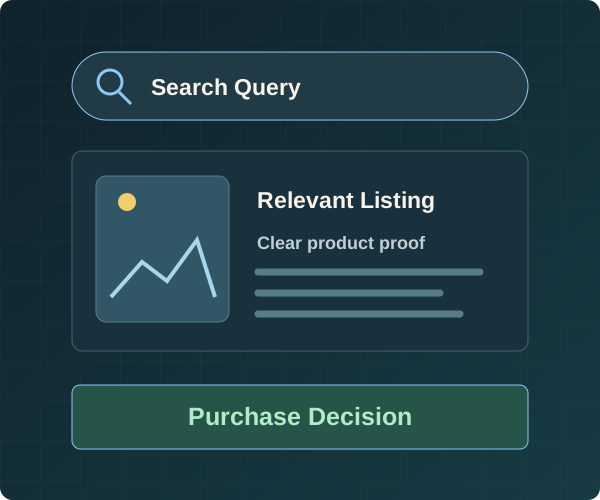
A listing has three jobs, and they are not the same job. It has to be found, which is a data problem. It has to be chosen from a row of competitors, which is a thumbnail and price problem. And it has to close, which is where the copy finally earns its place. Optimising the third while the first is broken is the most common way to spend a quarter and move nothing.
Found: The Half That Is Data, Not Writing
Before a word of copy matters, the listing has to be eligible to appear. That is governed by structured data, not prose:
- Browse node and category. A product filed in the wrong node competes in the wrong result set and against the wrong benchmark. This is the single most consequential field on a listing and it is set once, usually early, usually by whoever created the SKU.
- Attributes. The specific fields your category exposes: size, material, compatibility, intended use, age range. Empty fields do not simply look incomplete. They make the product ineligible for the filters shoppers narrow by, and they leave nothing for an assistant to match against a question about who the product is for.
- Variation family structure. A parent that should hold six children and holds three splits the review count and the sales history across listings that ought to be reinforcing each other.
- Availability. A listing that goes out of stock loses position, and the position takes materially longer to rebuild than the stock does.
If the structured layer is wrong, better copy is a louder version of a listing that is not in the room.
Search Query Performance Is the Only Honest Starting Point
Keyword tools tell you what a term is worth in the market. Search Query Performance tells you what it is worth to you: the queries your ASINs actually appeared for, your impression share, click share and purchase share against the total for that query.
That distinction changes what you do. A term with high volume where you already hold most of the purchase share is not an opportunity, it is a position to defend. A term with moderate volume where you have impressions and almost no clicks is a thumbnail or price problem. A term where you have clicks and no purchases is a listing problem, and it is the one worth rewriting for.
Three questions, in this order, before any copy is touched:
- Where do we have impression share and no click share? The image, the price or the review count is losing the row. Copy will not fix it.
- Where do we have click share and no purchase share? The shopper arrived and was not convinced. This is the listing's real job and where rewriting pays.
- Which queries do we not appear for at all? Usually a structured-data or relevance gap rather than a copy gap.
Titles Changed in 2026 and Most Guidance Did Not
Amazon capped titles at 75 characters across most categories on 27 July 2026. A great deal of listing advice still in circulation was written against a 200-character norm, and the keyword-stuffing tactics it recommends are no longer possible.
Seventy-five characters is roughly brand, product, and the one attribute a buyer filters on. It is a positioning exercise now rather than a coverage exercise: you are choosing which single distinguishing thing earns the space, not fitting in every synonym. That is a better constraint than the old one, and it punishes catalogs that never decided what their product was for.
Images Carry More of the Decision Than Copy Does
On a results page the shopper sees a thumbnail, a price, a star rating and a truncated title. The copy you spent a week on is not in that decision at all. It only matters after the click.
Which reorders the work: the main image decides whether anyone reads anything. The secondary images answer the objections that would otherwise send someone back to the results page: scale against a familiar object, what is in the box, how it installs, what it is not for. Reviews are the cheapest research available for this, and the complaints tell you which image is missing.
A+ Content, Honestly
A+ Content is worth doing and it is routinely oversold. What it reliably does is reduce returns and answer the objections that stop a purchase, which shows up in conversion and in your return rate rather than in rank.
You will also read, in a great many places, that A+ Content is read in full by Amazon's shopping assistant while remaining invisible to traditional search. That claim is plausible and it is not verified. Nobody repeating it has published a test. Build A+ because it converts and because it lowers returns, both of which you can measure. If the assistant reads it too, that is upside you did not pay for.
Takeaway
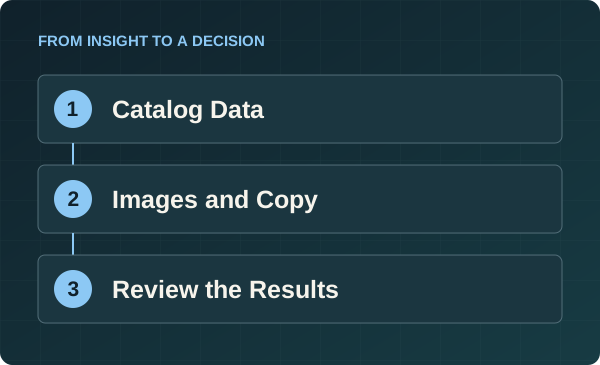
Run the order backwards from how most agencies sell it. Audit structured data first, read Search Query Performance second, fix images third, and rewrite copy fourth. Most catalogs find the largest single win in the first step, which is also the step nobody puts in a proposal because it does not look like work.
What Good Looks Like on a Cadence
- Daily, by exception: suppressions, stock, buy box, price errors. No meeting, just alerts that someone owns.
- Weekly: new query behaviour in Search Query Performance, and the listings whose click share moved.
- Monthly: catalog health across the whole set, not the top sellers. Variation families, attribute completeness, image counts.
- Quarterly: what to stop selling. The listings nobody is optimising because they are not worth optimising should be discontinued rather than carried.