
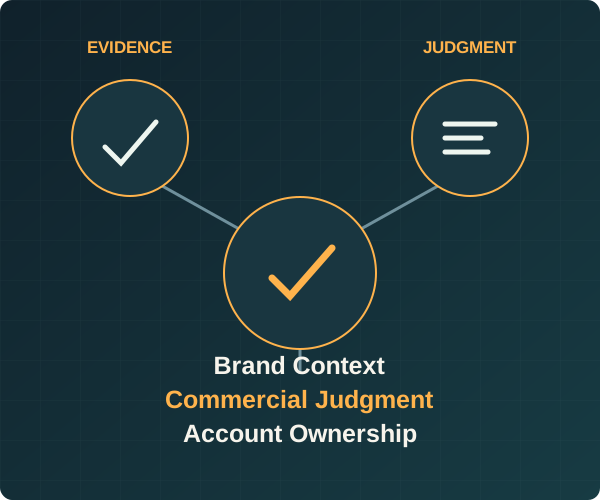
Search "best Amazon agency" and you get lists. The lists are mostly paid placements, and the criteria that would actually predict whether an agency works for a consumer brand are not in any of them.
Consumer brands have particular requirements, and they are not the requirements a generalist list is scored against.
Four Things Consumer Brands Need That Generic Advice Misses
- Brand control, not just performance. A consumer brand has positioning, a price architecture and retail partners who watch what happens on Amazon. An agency optimising purely for marketplace performance will happily discount into a channel conflict that costs more than the sale.
- Catalog complexity. Variations, multipacks, bundles, seasonal lines, licensed products. The coordination cost of getting these right is where most of the work actually sits, and it is invisible in an advertising-led proposal.
- Reseller and pricing control. Unauthorised sellers on your own listings suppress your buy box share and your price. This is enforcement work, and it is categorically different from marketing.
- The next channel. Walmart, TikTok Shop, retail. A consumer brand usually has somewhere to go next, and the decisions made on Amazon either make that easier or harder.
What "Best" Should Mean Here
Not the largest, not the most decorated. For a consumer brand, the useful definition is narrow: can they hold your brand's position while growing the channel's contribution, and will they tell you when those two conflict? Because they do conflict, regularly, and the conflict is where the value of good judgement actually sits.
Any agency that has never told a client not to run a promotion has either never had the conversation or lost it.
The Structural Question Underneath the Choice
Most of what separates agencies is not skill, it is model. Three shapes exist and they fail differently:
| Shape | Strength | How it fails |
|---|---|---|
| Advertising specialist | Deep, fast, measurable | Owns a console, not an outcome. Cannot fix a catalog or a fee problem |
| Full-service agency | Breadth, throughput, coverage | Owns a scope, not an outcome. Senior name on the pitch, junior manager on the account |
| Senior ownership plus resources | Decisions and capacity together | More expensive, and pointless for a catalog small enough for one person to run |
The question is not which is best in general. It is which failure mode you can least afford. A brand with a simple catalog and a pricing problem does not need breadth. A brand with four hundred SKUs across licensed lines does not need another specialist.
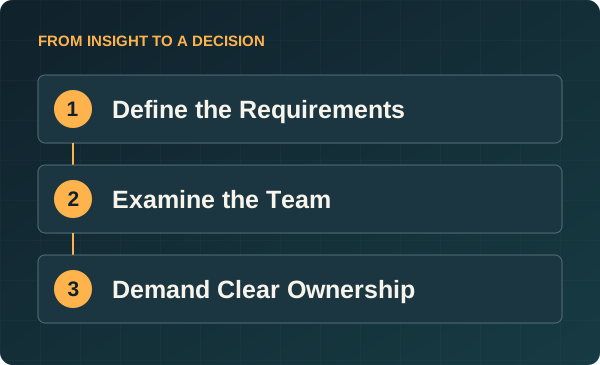
Six Questions That Separate Them Quickly
- Who is on my account on an ordinary Tuesday, by name, and what else are they on?
- What did you tell a client to stop doing last quarter?
- How would you find out which of my SKUs are unprofitable at current fees?
- Walk me through your last three escalations: the issue, who you took it to, what evidence you attached, how long it took.
- What do you need from us, and what happens when you do not get it?
- How do you get paid, and what makes that number go up?
The sixth is the one worth sitting with. If the answer is more spend or more hours, the incentive points away from you regardless of how good the people are.
Takeaway
Ignore the lists. Write down the two things that would most damage your brand if handled badly, which for most consumer brands are pricing integrity and catalog accuracy, then ask every agency how they handle exactly those. The answers separate faster than any capabilities deck, and the ones who have thought about it will say so in a sentence.