
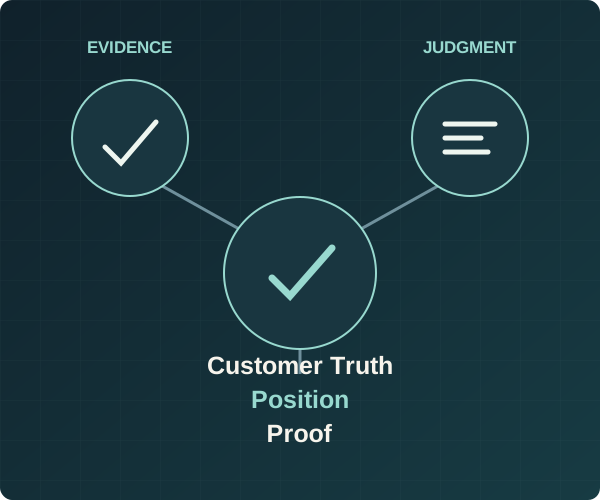
Most positioning work dies as a document. A deck is produced, the language is genuinely sharper, everyone agrees, and six weeks later the listings, the campaigns and the roadmap are exactly what they were. The failure is not the thinking. It is that nothing downstream was obliged to change.
Positioning Is Only Real When It Excludes Something
A positioning statement that would not embarrass anyone is not a position. The test is whether it tells you what to stop doing: a buyer you will not chase, a term you will not bid on, a product you will not make.
If the new positioning does not delete a line item, it has not been adopted. It has been admired.
The Chain From Truth to Execution
Each link has to be forced, because none of them happen on their own:
| Layer | The question | What changes if the answer changes |
|---|---|---|
| Customer truth | Who is buying, replacing what, deciding between which two options? | Everything below |
| Position | Which comparison do we intend to win, and which do we concede? | The catalog you invest in |
| Proof | What makes the claim believable in three seconds on a results page? | Images, title, review strategy |
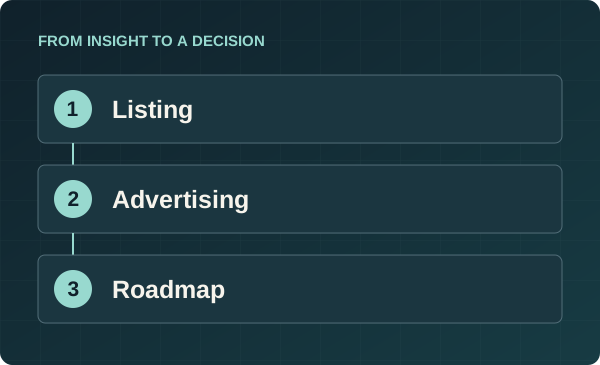
| Listing | Does the page argue that comparison, or describe features? | Copy, A+, imagery order |
| Advertising | Are we buying the queries where that comparison is happening? | Term selection, targets, budget split |
| Roadmap | Does the next product strengthen the position or dilute it? | What gets made |
Positioning that does not reach the advertising term list and the product roadmap has not left the document.
The Three-Second Test
On a results page the shopper sees a thumbnail, a price, a rating and a truncated title. That is the entire surface on which your positioning has to survive. A position that requires a paragraph to explain does not exist at the moment of choice.
So the practical question is not "what is our positioning". It is: which single visual or phrase makes the intended comparison obvious before anyone clicks? For some products it is the image showing scale. For others it is one word in the title. For most, nobody has decided, and the listing hedges across three possible positions.
Turning It Into Instructions
A position becomes a playbook when it produces rules a person can follow without re-deriving the strategy:
- A term rule. Which queries we buy, which we deliberately do not, and why. Written down, so the next person does not add them back.
- A listing rule. The one comparison every listing in the family must make, and the objection each must answer.
- A pricing rule. The band we hold and what we do when undercut, decided in advance rather than in the moment.
- A roadmap filter. A single question every proposed product must pass, which is usually whether it strengthens the comparison we intend to win.
How to Tell It Actually Landed
Ninety days after the positioning work, three things should be true. Something was stopped. The listing copy argues a comparison rather than listing features. And somebody who was not in the room can state the position in one sentence without looking it up.
Takeaway
Before accepting any positioning work, ask what it obliges you to stop doing. If the answer is nothing, you have bought a description of the business you already had, written more attractively.