
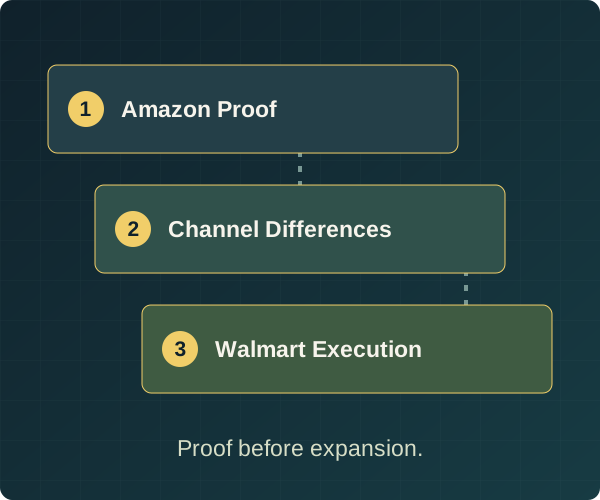
Walmart Marketplace is the only secondary channel with genuine seller demand behind it. In our keyword analysis it drew roughly 4,130 monthly seller-intent searches, against 530 for TikTok Shop and effectively none for Wayfair. That is a signal about where operators are actually looking, and it is worth acting on before the others.
What Transfers Almost Directly
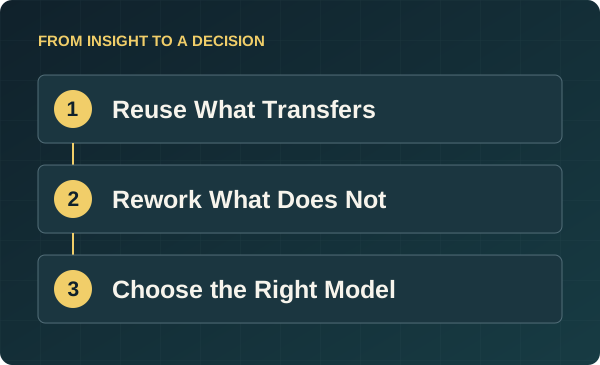
- Product data discipline. If your attributes, variations and category placement are clean for Amazon, that work carries. Walmart's taxonomy differs, but a catalog that has been made rigorous once is far cheaper to map than one that has not.
- Imagery and copy fundamentals. Writing for a shopper who cannot touch the product is the same skill.
- Fulfilment thinking. Walmart Fulfillment Services occupies a similar position to FBA in the decision: faster delivery promise, better placement, different fee arithmetic to model.
- Review and rating mechanics. Social proof works the same way, though you start from zero.
What Does Not Transfer, and Catches People Out
- The buyer is more price-led. Walmart's proposition centres on price in a way Amazon's does not. A product positioned on premium differentiation performs differently, and sometimes considerably worse, without a repositioned offer.
- Price is monitored across the internet. Walmart actively compares your price elsewhere, including on Amazon. A listing can be suppressed for being priced higher than the same item on another site. That single mechanic breaks the common plan of using Walmart as a higher-margin secondary channel.
- Less traffic, but also less competition. Fewer sellers per category means a well-executed listing can reach visible position faster than the equivalent effort on Amazon. That is the real opportunity and it decays as more sellers arrive.
- Content standards are stricter in places. Attribute completeness is enforced more literally, and a thin listing that survives on Amazon may simply not surface.
- The advertising platform is younger. Fewer levers, less granular reporting, and tactics ported from Amazon will not map one to one.
The plan to sell at a higher price on Walmart than on Amazon does not survive contact with Walmart's price monitoring.
The Decision Worth Making First
Not "should we expand", but which SKUs. The right initial set is usually narrow: products with clean data, a defensible price against the category, enough margin to absorb a second channel's overhead, and no dependency on a bundle or configuration that would need rebuilding.
Listing the full catalog is the standard mistake. It multiplies the operational surface immediately and produces a long tail of listings nobody has time to maintain, which then drags on account-level metrics.
What It Actually Costs
The fee schedule is the visible part and rarely the expensive one. The real cost is operational: a second set of listings to maintain, a second inventory position to forecast, a second support queue, a second set of account health metrics, and the management time to notice when something breaks. A brand that is already stretched on one marketplace will be stretched on two, and the second channel usually loses.
Takeaway
Before anything else, check what your candidate SKUs sell for everywhere else online, including any reseller you do not control. Walmart's price monitoring will find those listings, and a price mismatch you did not know about is the most common reason an otherwise well-built launch never gets visibility.