
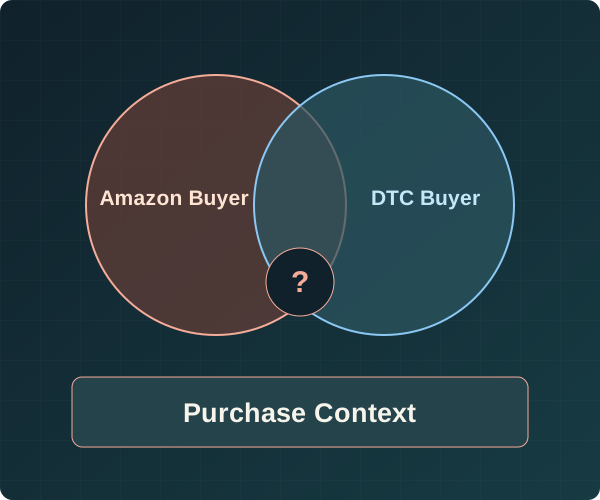
Brands with a strong direct-to-consumer business often port their positioning to Amazon unchanged and are puzzled when it underperforms. The product is the same and the customer is not, because the two channels select for different people at different moments.
Four Structural Differences
- Intent arrives differently. A DTC visitor usually arrives because of you: an ad, a recommendation, a search for your name. An Amazon shopper usually arrives because of the category. They are describing a need, and you are one of several answers.
- The comparison is on-screen. On your own site you control the context entirely. On Amazon your competitors are physically adjacent, with prices and review counts visible in the same glance.
- Trust is borrowed, not built. DTC requires you to establish credibility. Amazon lends you its own, then makes you compete on the proxies it exposes: reviews, rating, Prime, return policy.
- The decision is faster. A considered DTC purchase might involve several visits and an email sequence. The Amazon equivalent is often a single scroll.
Your DTC buyer chose you and then chose the product. Your Amazon buyer chose the product and may never register that it was you.
What This Changes in Practice
- Brand story belongs lower. The founding narrative that anchors your homepage is not what wins the results page. It can support the decision after the click; it cannot make the click happen.
- The differentiator has to be visible, not explained. If your advantage needs a paragraph, it will not survive a thumbnail. It has to be in the image, the title, or a number.
- Objections replace aspiration. DTC copy sells the outcome. Amazon copy earns the sale by removing the reasons not to buy, because the alternative is one row away.
- Price sits in a visible band. On DTC you set price against perceived value. On Amazon you set it against four visible competitors, and being outside the band requires the page to justify it immediately.
The Assortment Question Most Brands Skip
It does not follow that the same range should be on both. DTC rewards depth and personalisation. Amazon rewards clarity and a product that answers a described need without configuration.
The practical consequence is that your Amazon assortment is a deliberate selection rather than a mirror: the products that explain themselves in a thumbnail, in pack sizes that make sense to someone who has not read your site. Brands that list everything usually find that a long tail of configurable products drags the whole catalog's conversion down.

Where the Two Actually Help Each Other
This is not an argument for treating them as unrelated. Each answers a question the other cannot. DTC gives you the customer identity, the email, the reason they bought and the ability to ask. Amazon gives you demand signal at a scale DTC rarely reaches, and a live read on which claims survive next to a competitor.
Used together, the DTC channel is where you learn why, and the Amazon channel is where you learn whether it scales. Most brands run both and use neither to inform the other.
Takeaway
Open your own Amazon listing on a phone, in the results row rather than direct, beside the three competitors that appear next to it. Anything about your positioning that is not visible in that view is not working on this channel, whatever it is doing on your site.